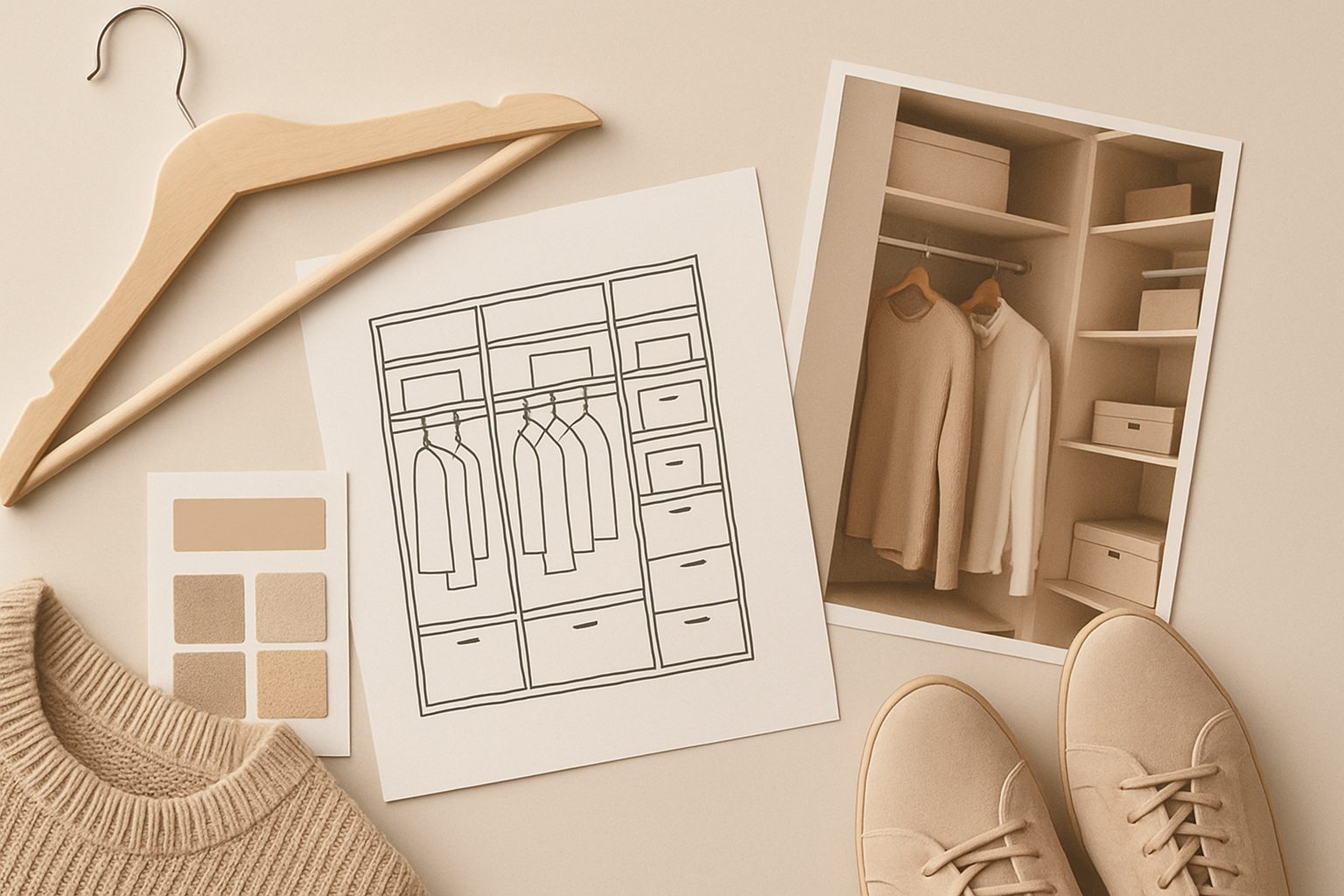
Walk-In Wardrobe with Island Unit UK: Is It Worth It? (Designs + Costs)
An island unit in a walk-in wardrobe sounds luxurious, and in the right space, it genuinely transforms how you use the room. But it's also a significant investment, and in many UK homes, it simply won't fit or won't pay for itself. Whether one suits you depends entirely on your wardrobe size, your room dimensions, and how you actually dress.
The short answer: if you have a walk-in larger than 12 square metres and you own enough clothes to justify dedicated display and folding space, an island unit is worth considering. If your walk-in is smaller or already feels snug, it'll feel like a barrier rather than a feature.
What is a walk-in wardrobe island unit?
An island unit is a freestanding or built-in storage structure in the centre of your walk-in wardrobe, with access from all sides. In fitted wardrobes, it typically houses:
- Open shelving for folded jumpers, t-shirts, or accessories
- A central drawer bank for jewellery, belts, scarves, or hosiery
- Sometimes a seating bench if space allows
- Occasionally a jewellery display unit or mirror inset
Unlike wall-mounted storage, the island creates a true focal point. You can walk around it, use it from multiple angles, and it breaks up what might otherwise feel like a corridor lined with rails and rails of clothes.
When an island unit makes sense
Island units work best in specific scenarios:
You have a genuinely spacious walk-in. Think 3m × 4m or larger. Anything smaller than 12 square metres starts to feel cramped once you've added an island and maintained proper circulation space around it. You need at least 60cm to 80cm of walking space on all sides.
You own significant quantities of folded items. If most of your wardrobe hangs (suits, dresses, coats), an island is less valuable. If you wear a lot of knitwear, t-shirts, jeans, or active wear that lives folded, the extra surface space becomes genuinely useful.
You spend time getting dressed in the space. Some people use their walk-in as a dressing room, and an island with a surface becomes a logical place to lay out an outfit or set down jewellery whilst deciding what to wear. If you grab items and dress elsewhere, this benefit disappears.
You want a visual focal point. An island breaks up rows of hanging rails and creates visual interest. If you're in the space daily, that matters.
Island unit sizing and layout rules
Proper sizing prevents an island from dominating the room and creating bottlenecks.
Width and depth. Most work well at 80cm to 100cm wide and 50cm to 80cm deep. Go wider than 100cm and you're effectively splitting your usable wardrobe into two rooms. Shallower than 50cm and drawer access becomes impractical.
Circulation space. You need a minimum 60cm walkway on all sides. If your walk-in is 3m × 4m and you're adding a 1m × 0.7m island, do the maths: 3m minus 0.7m (island depth) minus 0.6m (walkway each side) leaves you 0.7m of clear walking space along one axis. That's tight. Most designers suggest the island should take up no more than 20% of the total floor area.
Height. 90cm to 100cm is standard, matching typical base cabinet heights. Higher, and it feels imposing; lower, and drawers become awkward to access when you're folding or arranging clothes.
Corner placement. An island works best roughly centre-room or slightly offset. Tucking it into a corner defeats the purpose of having access on all sides and turns it back into a corner dresser.
Real costs to expect
A bespoke, built-in island unit for a UK walk-in typically runs £2,500 to £6,000+, depending on materials, finish, and whether you're adding it to an existing wardrobe or building everything together. Solid wood or veneer, soft-close drawers, internal dividers, and quality handles all push costs upward.
A mid-range fitted wardrobe designer (John Lewis, Hammonds, or a local joinery) might quote £3,500 to £5,000 for an island unit as part of a full walk-in redesign. Luxury bespoke makers charge £6,000 to £15,000+.
If you're considering a freestanding option—a robust sideboard or storage bench that mimics an island—expect £800 to £2,500 for something sturdy enough for daily use in a wardrobe.
Design benefits and drawbacks
Benefits:
- Dramatic visual upgrade; instantly feels more intentional
- Extra surface for jewellery display, perfume, or layout space
- Breaks up the "corridor" feeling of linear storage
- Seating or bench options make getting dressed more comfortable
Drawbacks:
- Takes up floor space in a room that's often already tight
- Reduces the perceived size of the room
- Creates a visual focus even if you'd rather the wardrobe feel open and airy
- Harder to reconfigure later; you're committed to the layout
- Can trap dust and clutter easily if drawers aren't organised
Should you get one?
Ask yourself three questions:
- Is your walk-in genuinely spacious (12+ square metres)?
- Do you own enough folded items to justify the investment?
- Are you happy committing to a centrepiece feature that's expensive and difficult to change?
If the answer to all three is yes, an island unit likely pays for itself in daily usability and visual satisfaction. If you're hesitating on space, start with a single freestanding piece—a velvet jewellery organiser on an open shelf or a simple storage bench—and see how it feels before investing in bespoke joinery.
For most people building a fitted wardrobe for the first time, the priority is getting the rails, shelves, and drawers around the walls right. Once that's solid, an island becomes an optional luxury that genuinely enhances the space—not something that should drive your entire budget.
More options
- Walk-In Wardrobe LED Strip Lighting Kits (Amazon UK)
- Wardrobe Interior Organisers & Accessories Bundle (Amazon UK)
- Modular Wardrobe Storage Systems (Amazon UK)
- Hollywood Vanity Mirror & Dressing Table Lighting (Amazon UK)
- Pull-Out Wardrobe Rails & Shoe Racks (Amazon UK)