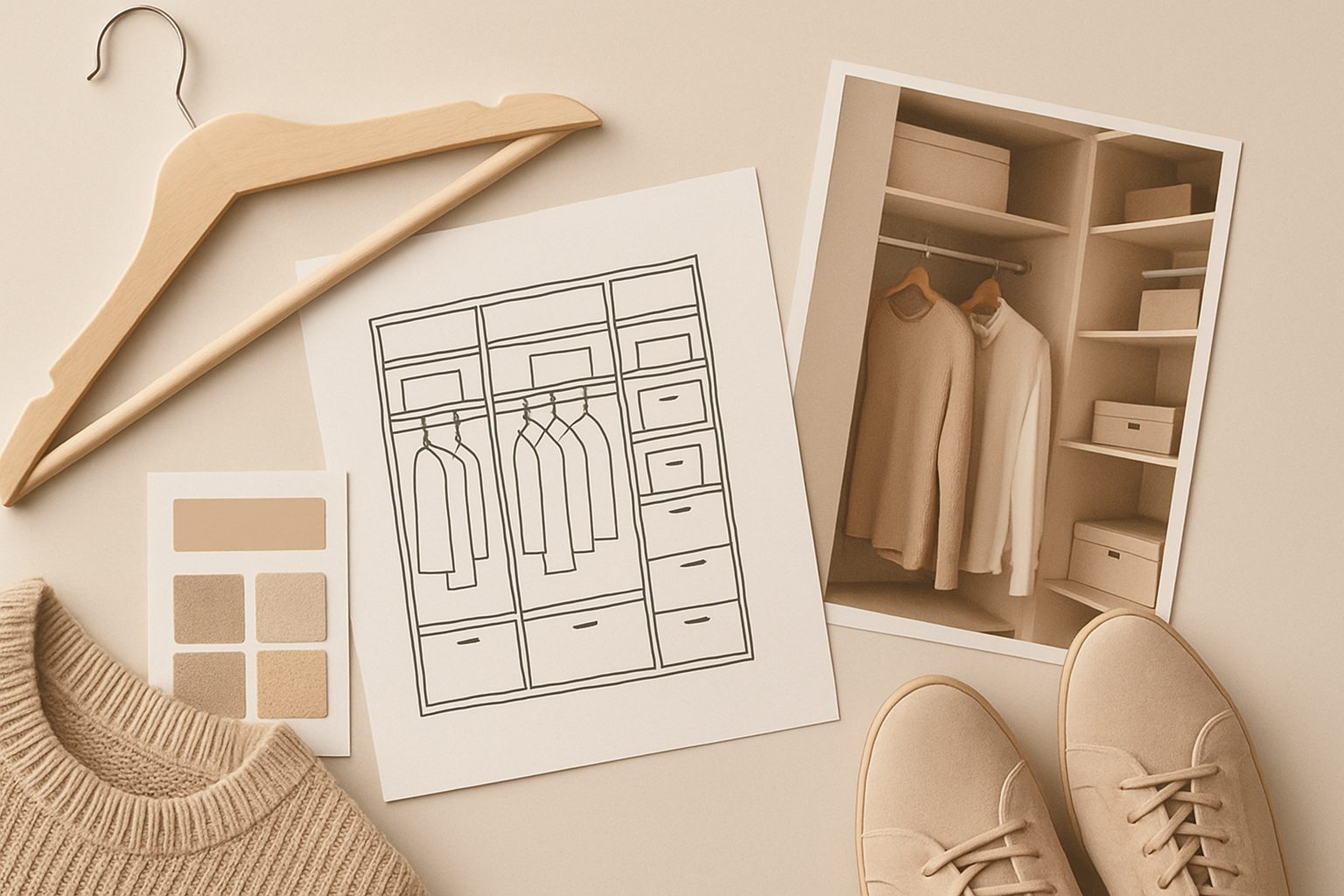
Walk-In Wardrobe Dimensions UK: Minimum Sizes, Layouts & Planning Rules
A walk-in wardrobe seems like a straightforward addition until you're standing in your spare bedroom trying to work out if 1.2 metres wide is actually workable. The truth is that minimum dimensions matter far more than most people realise. Too narrow and you'll spend three minutes manoeuvring past hanging rails; too shallow and you'll waste half your hanging space on poor access. This guide sets out the actual dimensions you need for each layout type, so you can plan something that functions rather than frustrates.
Minimum Dimensions for Walk-In Wardrobes
The absolute minimum floor space is roughly 1.5m × 1.5m, though this creates a cramped single-access wardrobe that works only for a small household. Anything smaller than 1.5m wide tends to feel claustrophobic and limits your hanging options to a single rail or two rails facing each other across a very tight gap.
For a more usable single-access wardrobe, aim for at least 1.8m × 1.5m. This gives you breathing room and lets you fit practical hanging solutions on both sides or a decent depth of storage along one wall. The width matters most because it determines how easily two people can pass, or whether you can comfortably stand in the middle while reaching clothes.
Ceiling height doesn't have a strict minimum, but 2.1m is the practical floor (most UK homes have 2.4m ceilings). Below 2.1m, full-length hanging becomes impractical for anyone taller than about 5'10". If you're working with a loft conversion or low room, you can still build a walk-in around mid-length hanging (around 1.6–1.8m of drop), but you'll need drawer or shelf storage for longer items.
Layout Types and Ideal Dimensions
Single-Access Wardrobe (One Entry Point)
| Dimension | Minimum | Comfortable | |-----------|---------|-------------| | Width | 1.5m | 1.8m–2.0m | | Depth | 1.2m | 1.5m | | Hanging rail drop | 1.6m–2.1m | 2.0m–2.1m |
Single-access wardrobes work best as rectangular spaces. The key constraint is the depth: anything shallower than 1.2m wastes space because you can't fit standard 45cm-deep hanging rails comfortably. At 1.5m depth, you can fit two rails back-to-back (one per side) with a walkway between, or one substantial rail with shelving or drawers opposite.
L-Shaped Wardrobe
| Dimension | Recommendation | |-----------|-----------------| | Long wall | 2.0m–2.5m | | Short wall | 1.2m–1.6m | | Minimum depth (walkway) | 1.0m–1.2m |
L-shapes are popular because they fit corner spaces and give you two distinct storage zones. The corner becomes slightly awkward to access, so reserve it for less frequently worn items or folded stock. The longer arm typically holds full-length hanging, whilst the short arm often works better as shelving or a row of drawers. Aim for at least 1.0m of clear floor space at the widest point so you're not forced to edge sideways.
U-Shaped Wardrobe
| Dimension | Recommendation | |-----------|-----------------| | Each side | 1.2m–1.8m | | Central walkway | 0.9m–1.2m | | Total depth | 2.0m–2.5m |
U-shapes maximise storage in modest floor footprints because you're using three walls instead of one. The trade-off is depth: a proper U takes up a lot of room lengthwise. The central walkway should be at least 0.9m wide, though 1.0–1.2m is more comfortable. Anything narrower than 0.9m feels like a corridor and makes it hard to access hanging rails from both sides simultaneously.
What Really Works vs. What Sounds Good on Paper
Shallow racks (30cm deep) sound space-efficient but aren't. They force you to overlap hangers or double-pole everything, which actually reduces usable hanging space. Standard 45cm rails are worth the depth.
Corner units rarely get used. A dead corner in a wardrobe is genuinely dead space. If you're building an L or U, accept that the corners will be awkward and either leave them empty or use them for off-season storage in boxes.
Shared wardrobes need more width than you'd expect. If two people share a walk-in, add 0.3–0.5m to your width recommendation. Access becomes the limiting factor; cramped shared wardrobes breed resentment faster than poor storage itself.
Internal shelving takes up useful floor space. If you're tempted to add shelves down the middle, remember you're halving your floorspace for walking. Better to shelve the walls.
Measuring and Planning Your Space
Before commissioning or building, measure three times: the floor dimensions (especially corners—many aren't square), ceiling height, and any obstacles like radiators, windows, or sloping eaves. UK fitted wardrobes often sit in awkward spaces; a wall that looks straight at eye level can be 5–10cm out by the time you reach the ceiling.
Mark out your intended layout on the floor with tape first. Walk through it, swing doors mentally, and test your reach to imaginary hanging rails. If it feels tight, it's probably too tight—wardrobes that work smoothly get used daily, whilst cramped ones become overflow storage.
Plan your rail heights before installation. Full-length items need about 1.65m of hang space; trousers and shirts need roughly 1.0m and 0.6m respectively. Mixing heights within a single rail almost always wastes space because people hang everything where it's easiest, not where it logically belongs.
Next Steps
Once you've settled on your dimensions, the next stage is costing—fitted wardrobes range from budget flat-pack options to bespoke joinery, and dimensions directly affect price. A proper measuring grid (or even scaled paper) helps builders quote accurately and prevents expensive mistakes on site.
More options
- Walk-In Wardrobe LED Strip Lighting Kits (Amazon UK)
- Wardrobe Interior Organisers & Accessories Bundle (Amazon UK)
- Modular Wardrobe Storage Systems (Amazon UK)
- Hollywood Vanity Mirror & Dressing Table Lighting (Amazon UK)
- Pull-Out Wardrobe Rails & Shoe Racks (Amazon UK)